Tell us about the job
Takes about a minute. No obligation.
Sizing a central AC system for a Medina County home is not purely a square-footage calculation. 96 severe weather events were recorded in Medina County, Ohio between 2015 and 2024. At that rate, severe weather is a real part of what a system here runs against, so a contractor has to build that load into how they size and position equipment rather than defaulting to a standard regional spec. That does not mean the install calls for the heaviest equipment on the shelf. It means the sizing work is specific to this address, this exposure, and what the weather here actually demands of a cooling system year after year.
Ductwork sized and routed for whatever system was original to the house is what a contractor has to assess before anything else on an installation job here. Half the homes in Medina County, Ohio were built in 1985 or earlier (2020-2024 ACS 5-year). That vintage of construction predates the equipment and the load calculations that drive modern central AC design, which means the existing duct layout may have been retrofitted once or more already. Whether it can carry a new system without being reworked is a question of what is physically behind the walls and under the floors, and the answer changes the scope of the job before the unit itself is ever priced.
What Gets Installed With a New Central AC
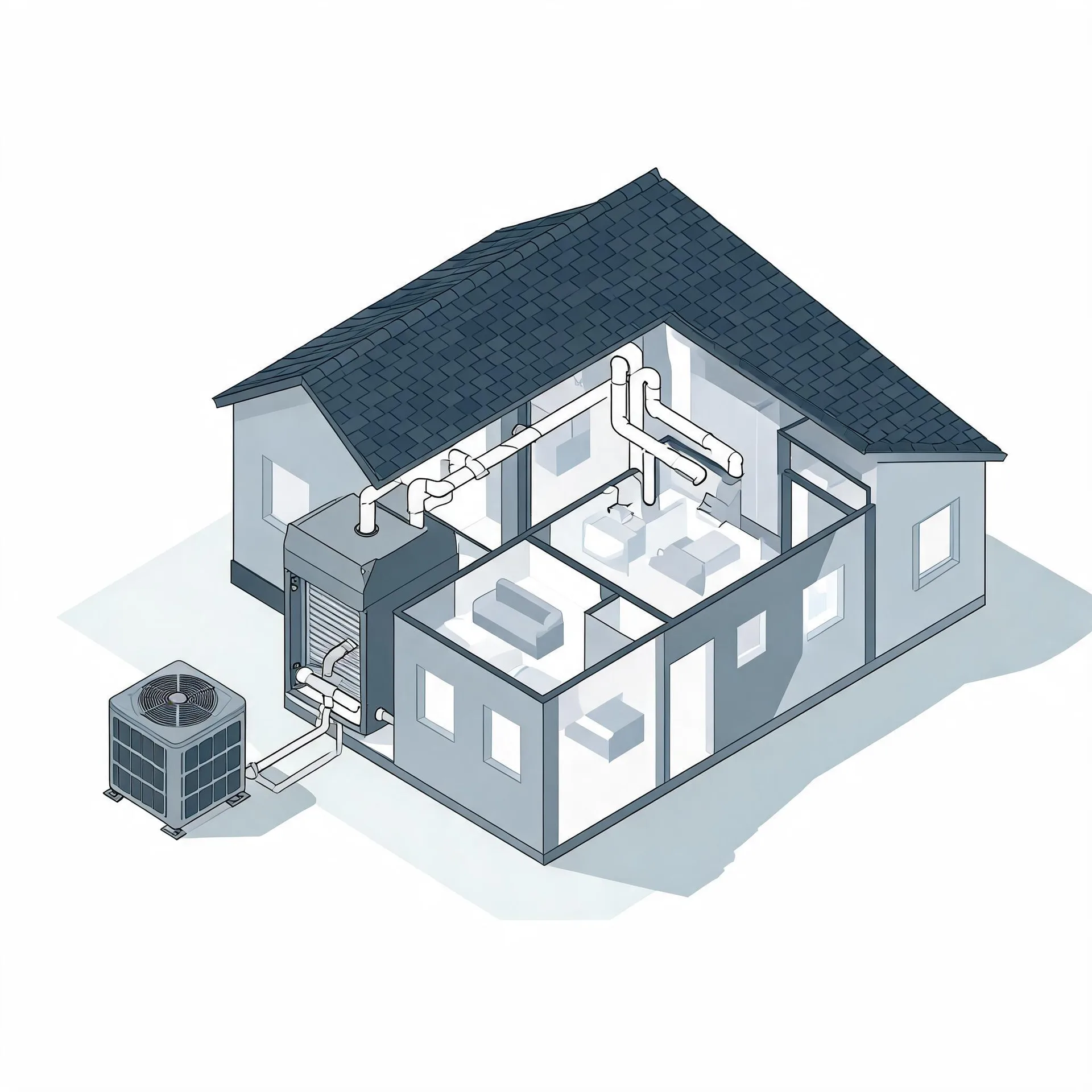
The outdoor condenser unit sits outside the house, usually on a concrete pad beside the foundation, and houses the compressor and condenser coil. Inside, the air handler or furnace-mounted evaporator coil takes its place in a utility space, basement, or closet. Those two units are the core of what a contractor puts in.
A refrigerant line set runs between the indoor and outdoor units, connecting them through the wall or up through the structure. The thermostat goes on an interior wall where it can read the home's air accurately, and it becomes the control point for the whole system.
The drawing shows a typical layout, and a licensed contractor determines exactly what applies to this house.
Find a contractor in Medina CountyMedina County, by the numbers
96 severe weather events were recorded in Medina County, Ohio between 2015 and 2024.
NOAA National Centers for Environmental Information, Storm Events Database, bulk CSV export, events 2015-01-01 through 2024-12-31.Half the homes in Medina County, Ohio were built in 1985 or earlier (2020-2024 ACS 5-year).
U.S. Census Bureau, 2020-2024 American Community Survey 5-Year EstimatesMedina County, Ohio holds 76,202 housing units (2020-2024 ACS 5-year).
U.S. Census Bureau, 2020-2024 American Community Survey 5-Year EstimatesOwners occupy 80.3% of the occupied homes in Medina County, Ohio (2020-2024 ACS 5-year).
U.S. Census Bureau, 2020-2024 American Community Survey 5-Year EstimatesCodes & Standards Governing Central AC Installation in Medina County, Ohio22 sourced rules & standards
What the Installation Actually Looks Like
Split-system central air conditioners rated below 45,000 Btu/h manufactured on or after January 1, 2023 must meet a federal minimum of 13.4 SEER2.
Split-system central air conditioners rated at or above 45,000 Btu/h manufactured on or after January 1, 2023 must meet a federal minimum of 13.4 SEER2.
Split-system central air conditioners manufactured between January 1, 2015 and December 31, 2022 had to meet 13 SEER, the metric that preceded SEER2.
Single-package central air conditioners manufactured on or after January 1, 2023 must meet a federal minimum of 13.4 SEER2.
Space-constrained central air conditioners manufactured on or after January 1, 2023 must meet a federal minimum of 11.7 SEER2.
Federal efficiency standards for split-system central air conditioners and heat pumps are set on each certified combination of outdoor unit and indoor coil rather than on the outdoor unit alone.
Residential and light commercial air conditioning and heat pump systems assembled in the field, including mini-splits and unitary systems, may not be installed on or after January 1, 2025 using a refrigerant with a global warming potential above 700.
A field-assembled system whose specified components were all manufactured or imported before January 1, 2025 carries no installation compliance date under the refrigerant restrictions and may still be installed.
Licensing and Legal Requirements in Medina County, Ohio
An Ohio home construction services contract must include a copy of the supplier's certificate of insurance showing general liability coverage of not less than two hundred fifty thousand dollars.
In Ohio a home construction service means the construction of a residential building, including the repair, improvement, remodel or renovation of an existing structure, and does not include construction on a structure containing four or more dwelling units except for work on an individual dwelling unit within it.
A home construction service supplier in Ohio is defined as a person who contracts with an owner to provide home construction services for compensation and who maintains a general liability insurance policy of not less than two hundred fifty thousand dollars.
The Ohio construction industry licensing board issues state licenses to individuals as heating, ventilating and air conditioning contractors, refrigeration contractors, electrical contractors, plumbing contractors and hydronics contractors.
An Ohio board of county commissioners may accept a valid and unexpired Chapter 4740 license held by a heating, ventilating and air conditioning contractor toward its own licensing requirements for work on one-, two-, or three-family dwelling houses.
An Ohio board of county commissioners may adopt rules licensing heating, ventilating and air conditioning contractors who are not required to hold a state license under Chapter 4740.
In Ohio municipal law a specialty contractor includes heating, ventilating and air conditioning contractors, refrigeration contractors, electrical contractors, plumbing contractors and hydronics contractors.
An Ohio board of county commissioners may not register a specialty contractor who is required to hold a license under Chapter 4740 but does not hold a valid one.
An Ohio municipal corporation may not register a specialty contractor who is required to hold a license under Chapter 4740 but does not hold a valid one.
In Ohio building law a residential building means a one-family, two-family or three-family dwelling house and any accessory structure incidental to it, and does not include an industrialized unit, a manufactured home or a mobile home.
Ohio's contractor licensing chapter reaches only work on a construction project, and a construction project is defined to exclude residential buildings, so an HVAC contractor working on a one-, two-, or three-family dwelling in Ohio falls outside the state licensing requirement.
Violating Ohio's contractor licensing prohibition is a minor misdemeanor on a first violation and a misdemeanor of the fourth degree on subsequent violations.
Under Ohio law no person may act as or claim to be a type of contractor that Chapter 4740 licenses unless that person holds a license issued under that chapter.
In Ohio a home construction service supplier may not perform a home construction service costing twenty-five thousand dollars or more without entering into a written home construction services contract with the owner, unless the supplier and owner enter into a cost-plus contract.
Severe Weather Events in Medina County
Weather patterns shape how hard heating and cooling equipment has to work, and how often. A system sized and installed for local conditions holds up differently than one that is not, and that gap matters most in a place with real seasonal pressure.
96 severe weather events, 2015–2024. Source: NOAA National Centers for Environmental Information, Storm Events Database.